

What Is Ramadan?
Meaning, Importance & Global Observance
Discover the true meaning of Ramadan Mubarak, its importance in Islam, and how Muslims Worldwide observe fasting, prayer, and charity in this Holy month.
The month of Ramadan Mubarak is one of the most important times of the year for Muslims around the world. During this month, Muslims change their lifestyle and overall routine to focus on worship, fasting, self-control, and doing good deeds. Any small act of worship or good deed has far greater rewards in the eyes of Allah as compared to normal days in this month.
Let’s discuss in more detail about Ramadan? Why it is so important and how Muslims around the world observe it.
What is the Meaning of the Word ‘Ramadan’?
Ramadan is a word of Arabic origin. According to many scholars, the term Ramadan is related to heat or dryness, which means that sins are burned by means of worship and self-control. To put it simply, Ramadan is the month of Muslims trying to become better people, both spiritually and morally.
By observing fast and refraining from doing sinful acts, a person draws closer to Allah and gets showered with countless blessings.
When Does Ramadan Start and end? (Dates, Calendar & Moon Sighting)
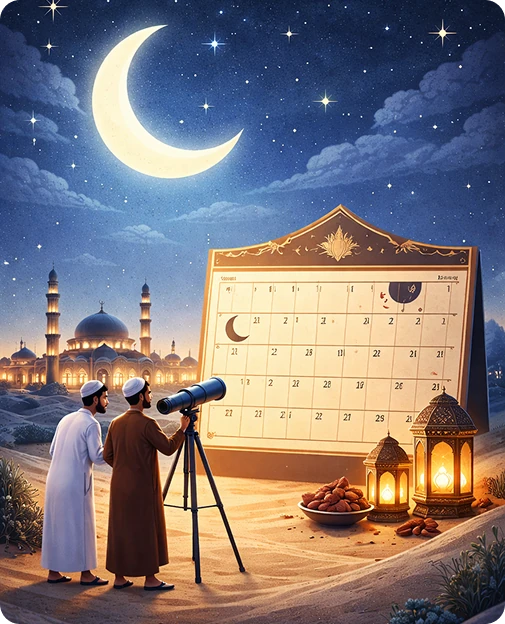
Ramadan Mubarak is the 9th month of the Islamic calendar, also known as the Islamic lunar calendar. It is called a lunar calendar because it follows the moon’s cycle instead of the sun’s cycle. It does not have fixed dates like the Gregorian calendar. Every year, the month shifts by approximately 10-11 days in relation to the Gregorian calendar.
This month starts with the new moon and is confirmed by observing the moon (usually a crescent). Ramadan begins when the crescent is observed, and Muslims wish each other Ramadan greetings.
Ramadan ends at sunset on the last day of fasting, and Eid al-Fitr begins the next day. Because Ramadan is based on moon sightings, the exact end date can vary from country to country. In some places, Ramadan may end a day earlier or later, depending on when the new moon is seen.
Fasting in Ramadan
Ramadan Fasting is one of the main acts of worship during this Holy month. Every healthy adult Muslim is required to fast, without exception. The daily fast begins at dawn and ends at sunset. That means Muslims do not eat or drink during daylight hours.
Allah says in the Quran:
“…and eat and drink until the white thread of dawn becomes distinct to you from the black thread of night, then complete the fast until sunset.”
(Quran 2:187)
This verse clearly defines the fasting time: from dawn to sunset.
What to Avoid During Fasting?
Fasting requires self-control, and any Muslim who is fasting should avoid the following:
Any sinful actions that Allah and His Prophet have forbidden should be avoided at all costs while fasting. The Prophet Muhammad specifically said:
“Whoever does not give up false speech and acting upon it, Allah has no need of him leaving his food and drink.”
(Sahih al-Bukhari 1903)
Who celebrates Ramadan?
Ramadan is celebrated by Muslims worldwide. Muslims observe Ramadan as a holy month of fasting, prayer, and reflection. During this time, adult Muslims fast from dawn to sunset, increase their prayers, read the Qur’an, and help those in need.
People of all ages take part:
In simple words, Ramadan is celebrated by Muslims worldwide as a special month in Islam.
Who is Exempted From Fasting?
While fasting is compulsory for every adult Muslim male and female, there are exceptions to this rule. Islam is not a strict religion that forces everyone to adhere to its strict rules without any flexibility. People who may not fast include:
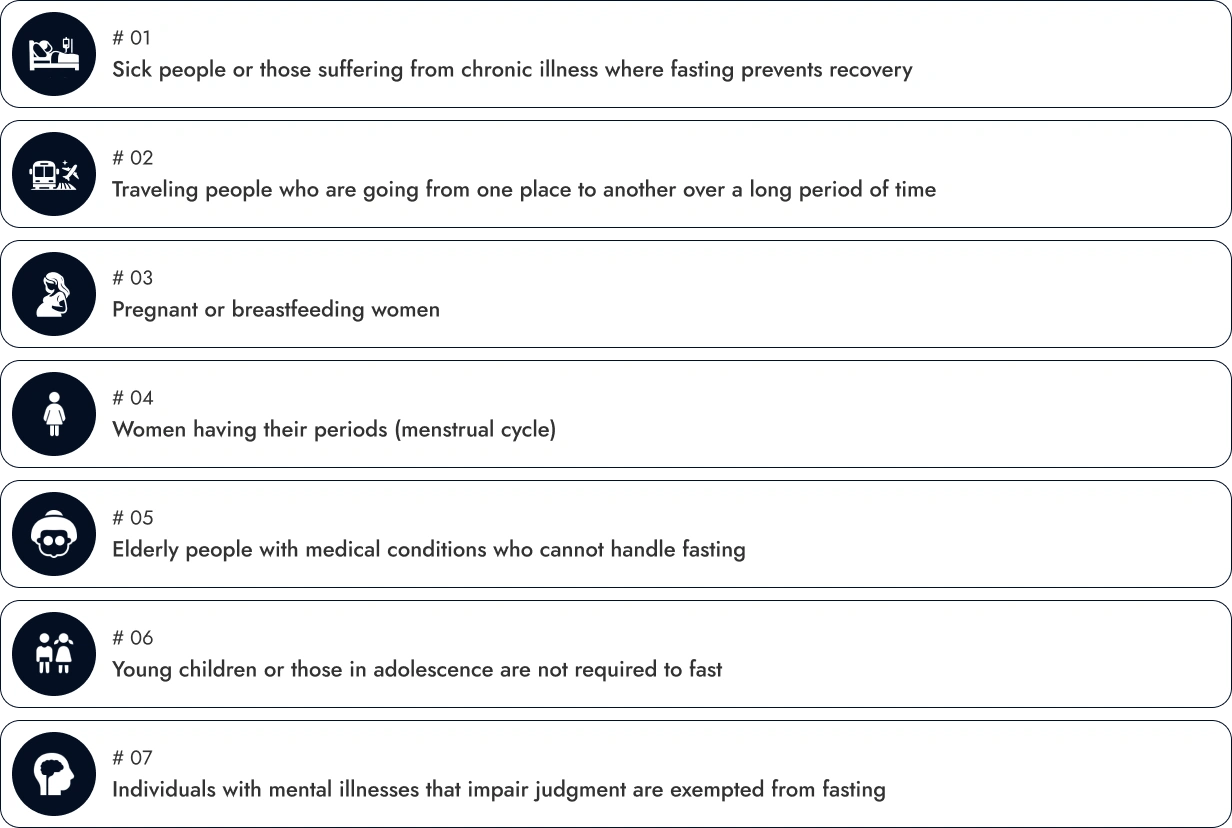
Who is Exempted From Fasting?
While fasting is compulsory for every adult Muslim male and female, there are exceptions to this rule. Islam is not a strict religion that forces everyone to adhere to its strict rules without any flexibility. People who may not fast include:
How to Make Up for Missed Fasting?
There are many ways to make up for missed fasting depending on the situation. Such as:
Making Up the Fast Later (Qada)
A person who is ill, traveling, or in pregnancy should make up for missed fasting by observing it later after Ramadan if needed. Allah clearly mentions this in the Quran:
“…And whoever is ill or on a journey, then an equal number of other days (must be made up). Allah intends for you ease and does not intend hardship for you…”
(Quran 2:185)
This is clear proof while missing fasts due to illness or travel is allowed; however, the person must fast the same number of days later.
Giving Charity Instead (Fidya)
Some people cannot fast at all, such as old people or those who have long-term health problems, and fasting would seriously harm them every time. They can give Fidya. As Allah states in the Quran:
“…And upon those who are able (to fast) but with hardship — a ransom (is due): feeding a poor person…”
(Quran 2:184)
Fidya means: Feeding one poor person for each missed fasting day. So if someone misses: 30 days → they feed 30 poor people (or feed 1 poor person for 30 days).
Suhoor and Iftar in Ramadan
Although Muslims fast throughout the day, they have two main meals during Ramadan, which are:
Suhoor (Pre-Dawn Meal)
The pre-dawn meal is called Suhoor (Sehri). It is also referred to as the pre-fast meal. This meal is very important as it provides energy and hydration for the long fasting hours during the day. Most Muslims attempt to consume balanced foods such as whole grains, eggs, yogurt, fruits, and lots of water in order to be able to remain active throughout the day.
The Prophet Muhammad (PBUH) said this about Suhoor:
Eat Suhoor, for in Suhoor there is blessing
(Sahih al-Bukhari, 1923)
Suhoor is also spiritual as it aids Muslims to be ready for the Fajr prayer and to start the day with worship by waking up early.
Iftar (Breaking the Fast)
After fasting for whole day Muslims break their fast at sunset through iftar. Muslims follow the Sunnah of breaking the fast with dates and water before eating a full meal.
Iftar is a very special moment as it is a time of gratitude, relief, and making dua (supplication) to Allah. Families often to sit down together to break fast and make prayer and mosques also host iftar meals to bring everyone closer in the community.
The Prophet Muhammed (PBUH ) said about breaking fast:
“When any one of you breaks his fast, let him break it with dates. If he cannot find dates, then let him break it with water, for it is a means of purification.”
(Sunan Ibn Majah, 1699)
Suhoor is also spiritual as it aids Muslims to be ready for the Fajr prayer and to start the day with worship by waking up early.
Taraweeh Prayers in Ramadan
Ramadan is also known for increased worship at night. Muslims perform extra prayers, after Isha namaz, known as Taraweeh. The Prophet Muhammad (PBUH) said this about Taraweeh:
“Whoever prays during Ramadan with faith and seeking reward, his past sins will be forgiven”
(Sahih al-Bukhari, 1802)
This shows the importance of Taraweeh prayers and the rewards you get by performing them.
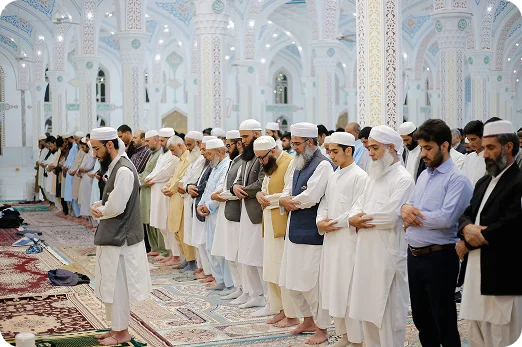
How to Perform Taraweeh Prayers?
The Taraweeh prayer is recited in sets of two rakats each, as Muslims do when praying the standard salah (prayers). Many mosques around the world hold ‘Taraweeh’ prayers, giving the chance to the community to gain blessings of this act of worship and, more importantly, reflect upon recitation of the Quran.
Taraweeh prayers can be performed at home if someone is unable to go to the mosque or they can’t find a mosque nearby.
Night of Laylat-ul-Qadr in Ramadan
Laylatul Qadr means The Night of Decree or The Night of Power. Some scholars have defined ‘Qadr’ as a ‘decree’, meaning it is the night during which the destiny of each person is decided and sealed for the coming years. Other scholars define ‘Qadr’ as ‘power’, indicating the greatness of the night.
It is one of the greatest blessings of Ramadan is Laylat al-Qadr, which is believed to fall in the last ten nights, especially on odd-numbered nights
The Prophet Muhammad (PBUH) said about this:
“Look for the Night of Qadr in the last ten nights of the month of Ramadan”
(Sahih al-Bukhari, 2020)
The reward for praying at night of Qadr is equal to the reward for praying for a thousand nights. This night is a major opportunity for forgiveness, mercy, and answered prayers. Many Muslims spend the last ten days focusing heavily on worship.
Allah says in the Quran:
“The Night of Decree is better than a thousand months.”
(Quran 97:3)
Charity and Good Deeds in Ramadan
Ramadan strongly emphasizes charity and helping others. Muslims believe rewards for good deeds are multiplied in this month. The Prophet Muhammad (PBUH) was especially generous in Ramadan:
“The Prophet was the most generous of all the people, and he used to become more generous in Ramadan when Gabriel met him”
(Sahih al-Bukhari, 3554)
Charity can be given in numerous ways, such as:
- Giving money
- Feeding fasting people
- Supporting the poor
- Donating meals and food packages
How is Ramadan Observed Worldwide?
Ramadan is observed in many different ways by Muslims throughout the world depending on the culture and traditions of the country. Whether Muslims are in majority or minority they tend to observe it in the best way they can.
Middle East
Ramadan is a part of the everyday life in the Middle East. The working hours are shortened, restaurants are closed during the fasting hours, and evenings are full of family meetings and prayers.
Asia and Africa
Ramadan is celebrated in such countries as Indonesia, Pakistan, Nigeria, and Egypt with local traditions, special food, and community events.
Europe and North America
Muslim communities in the West tend to fast without pausing school and employment. Mosques have joint iftars and prayer evenings.
The End of Ramadan: Eid al-Fitr
Ramadan ends with Eid al-Fitr, a day of celebration, prayer, gratitude, and family gatherings.
The Prophet Muhammad (PBUH) said:
“The fasting person has two joys: one when he breaks his fast and one when he meets his Lord.”
(Sahih al-Bukhari, 1904)
Conclusion
Ramadan is a month of special days for Muslims during which they fast, pray, read the Quran Especially Surah Yaseen, and perform good deeds. It teaches patience, self-control, and kindness to others. It is celebrated differently by Muslims all over the world, yet the aim is the same: to be closer to Allah and become a better person.